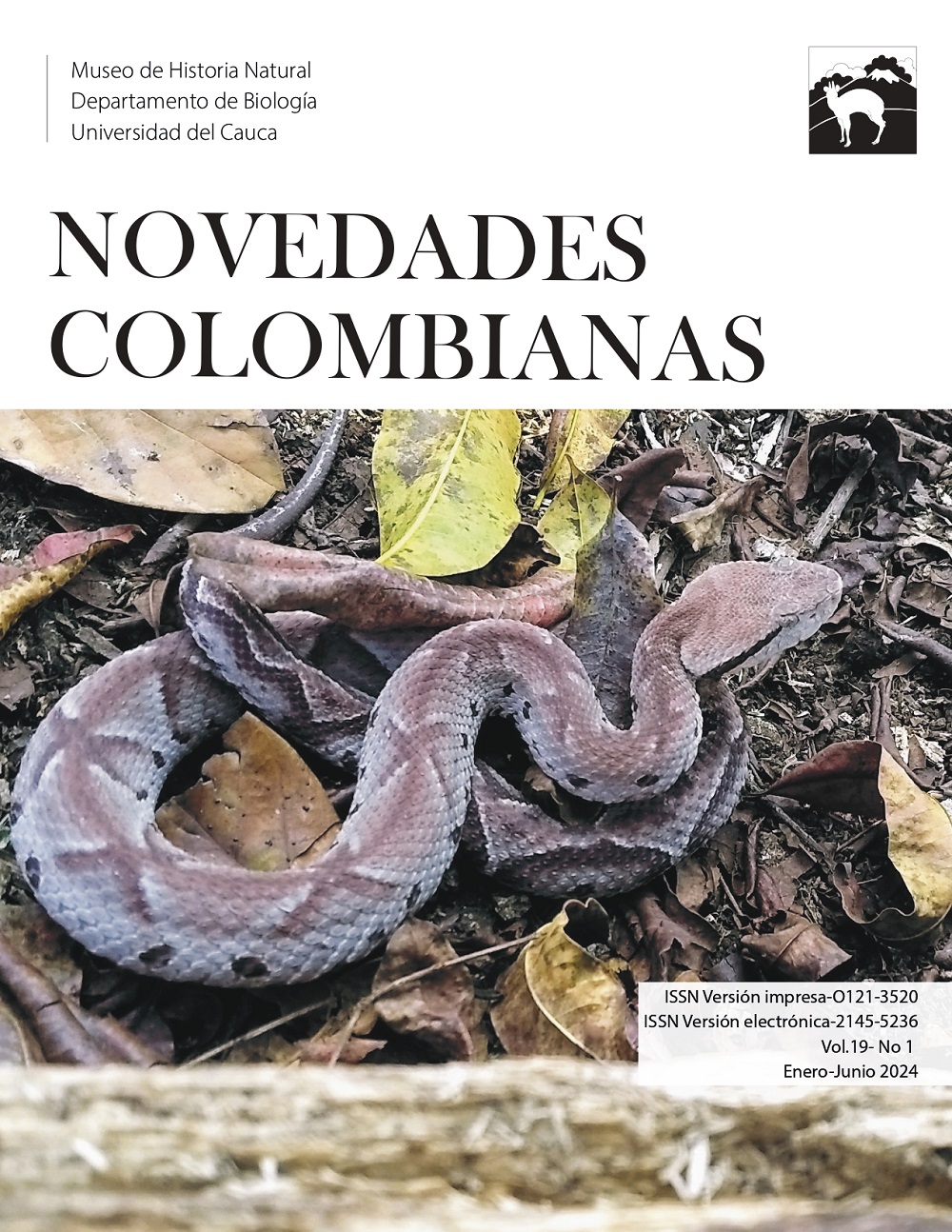
Four physiopathological effects of the venom of Bothrocophias colombianus (Rendahl & Vestergren, 1940) endemic to the colombian Pacific
Toxinological profile of the venom of Bothrocophias colombianus
Abstract
Belonging to the Viperidae family, Crotalinae subfamily, Bothrocophias colombianus, the Colombian toad-headed pitviper or equis colorada, is a species of venomous snake found in the humid rainforests of the Pacific coast of Colombia, where the lack of knowledge of the effects of its venom greatly hinders medical care. Therefore, in an effort to knowledge the effects of the venom B. colombianus venom, gaining an understanding of the local effects by calculating the minimum edematous (MED) and minimum hemorrhagic (MHD) doses, establishing the lethal dose 50 (LD50) in mice of the CFW strain, and examining any systemic effects from a determination of the minimum coagulant dose (MCD) in human blood plasma. The results revealed the LD50 of this venom as 199.5 μg of venom/mouse. There were hemorrhagic (1.06 ± 0.47 μg of ) and edematizing effects (0.45 ± 0.15 μg), in addition to a slight coagulant effect (21.02 ± 0.82 μg). In conclusion, the clinical picture of envenomation caused by this species could be characterized by strong hemorrhagic and edematous alterations and slight impairments in the coagulation cascade.
Downloads
References
Angel-Camilo, K.L., Guerrero-Vargas, J.A., de Carvalho, E.F., Lima-Silva, K., de Siqueira, R.J.B., Freitas, L.B.N., de Sousa, J.A.C., Mota, M.R.L., dos Santos, A.A., Neves-Ferreira, A.G.C., Havt, A., Leal, L.K.A.M. & Magalhaes, P.J.C. 2020. Disorders on cardiovascular parameters in rats and in human blood cells caused by Lachesis acrochorda snake venom. Toxicon 184, 180–191. https://doi.org/10.1016/j.toxicon.2020.06.009
Ayerbe, S. 1998. Aspectos clínicos y epidemiológicos del accidente ofídico en el departamento del Cauca, pp. 91-100. In Otero Patiño, R., Ángel Mejía, R. & García, M.E. (eds): Primer Simposio Colombiano de Toxinología. Memorias, 276 pp. Editorial Ecográfica Ltda, Medellín, Antioquia (Colombia).
Ayerbe-González, S. & Latorre-Ledezma, J. P. 2010. Manual para la prevención y mejoramiento en la atención del paciente con accidente ofídico (Tercera ed).
Ayerbe, S. 2021. Serpientes, Accidentes & Soluciones. https://ayerbedocserpientes.com, Popayán, Cauca, Colombia, pp. 1-116.
Campbell, J.A. & Lamar, W.W. 1989. The Venomous Reptiles of Latin America. Cornell University Press, Ithaca, New York.
Campbell, J.A. & Lamar, W.W. 2004. The Venomous Reptiles of the Western Hemisphere. Cornell University Press, Ithaca, New York.
Castro, F., Ayerbe, S., Calderón, J.J. & Cepeda, B. 2005. Nuevo registro para Colombia de Bothrocophias campbelli y notas sobre B. colombianus y B. myersi (serpentes: Viperidae). Noved. Colomb. 8, 1–9.
Castro, Zingali, R.B., Albuquerque, M.G., Pujol-Luz, M. & Rodrigues, C.R. 2004.Snake venom thrombin-like enzymes: from reptilase to now. Cell. Mol. Life Sci. 61,843–856. https://doi.org/10.1007/s00018-003-3325-z
Chippaux, J.-P., Williams, V. & White, J. 1991. Snake venom variability: methods of study, results and interpretation. Toxicon 29, 1279–1303. https://doi.org/10.1016/0041-0101(91)90116-9
Gutberlet Jr., R.L. & Campbell, J.A. 2001. Generic recognition for a neglected lineage of South American pitvipers (Squamata: Viperidae: Crotalinae), with the description of a new species from the Colombian Chocó. Am. Mus. Novit. 3316, 1–15.
Gutiérrez, J.M., Rojas Céspedes, G., Lomonte, B., Gené, J.A., Chaves Mora, F., Alvarado, J., Rojas & Umaña, E., 1990. Standardization of assays for testing the neutralizing ability of antivenoms. Toxicon 28 (10), 1127–1129. https://doi.org/ 10.1016/0041-0101(90)90110-s
Gutiérrez, J.M. & Rucavado, A., 2000. Snake venom metalloproteinases: their role in the pathogenesis of local tissue damage. Biochimie 82, 841–850.
Gutiérrez, J., 2002. Comprendiendo los venenos de serpientes: 50 años de investigaciones en América Latina. Revista de Biología Tropical, 2.
Gutiérrez, J.M., Rucavado, A., Solano, G., Lomonte, B., Herrera, M., Segura, Á., Villalta, M., Vargas, M., Escalante, T., León Vargas, G., Escalante, T., León, G., Pazos, F. & Álvarez, C. 2015. Métodos para el estudio de actividades tóxicas de venenos de serpientes. Estrategias y Avances en el Estudio de Toxinas de Interés Para la Biomedicina. Benemérita Universidad Autónoma de Puebla, México, pp. 19–45.
Jenkins, T.P., Sánchez, A., Segura, Á., Vargas, M., Herrera, M., Stewart, T.K., León, G. & Gutiérrez, J.M. 2017. An improved technique for the assessment of venom-induced haemorrhage in a murine model. Toxicon 139, 87–93. https://doi.org/10.1016/j.toxicon.2017.10.005
Jiménez-Porras, J.M. 1970. Bioquímica, farmacología y fisiopatología de los venenos de serpientes. Rev. Univ. Costa Rica 28: 43-55.
Lomonte, B, Tarkowski, A. & Hanson, L.A. 1993. Host response to Bothrops asper snake venom: analysis of edema formation, inflammatory cells, and cytokine release in a mouse model. Inflammation 17, 93–105.
Lloret, S., & Moreno, J. J. 1993. Oedema formation and degranulation of mast cells by phospholipase A2 purified from porcine pancreas and snake venoms. Toxicon, 31(8), 949–956. https://doi.org/10.1016/0041-0101(93)90254-G
Lynch, J. D. 2012. El contexto de las serpientes de Colombia con un análisis de las amenazas en contra de su conservación. Revista Académica Colombiana, XXXVI(1), 15.
Martínez-Vargas, A. Z. 1990. Química y farmacología del veneno de serpientes (1 Parte). Revista de Química, IV(1), 25–46.
Méndez, A.R.M. & Moreno, R.M.F. 2009. Dosis letal 50 del veneno de Bothrops venezuelensis y Bothrops Colombiensis (Serpientes, Viperidae) en ratones NMRI y BALBC. Trabajo de Grado. Escuela de Ciencias de la Salud, Departamento de Medicina Interna, Universidad de Oriente.
Mora-Obando, D., Salazar-Valenzuela, D., Pla, D., Lomonte, B., Guerrero-Vargas, J.A., Ayerbe, S., Gibbs, H.L. & Calvete, J.J. 2020. Venom variation in Bothrops asper lineages from north-western South America. J. Proteomics 229, 103945. https://doi.org/10.1016/j.jprot.2020.103945
Pereañez,J.A., Preciado, L.M., Fernández, J., Camacho, E., Lomonte, B., Castro, F., Cañas, C.A., Galvis, C. & Castaño, S. 2020. Snake venomics, experimental toxic activities and clinical characteristics of human envenomation by Bothrocophias myersi (Serpentes: Viperidae) from Colombia. J. Proteomics 220, 103758. https:// doi.org/10.1016/j.jprot.2020.103758
Salazar-Valenzuela, D., Mora-Obando, D., Fernández, M.L., Loaiza-Lange, A., Gibbs, H.L. L., & Lomonte, B., 2014. Proteomic and toxicological profiling of the venom of Bothrocophias campbelli, a pitviper species from Ecuador and Colombia. Toxicon 90, 15–25. https://doi.org/10.1016/j.toxicon.2014.07.012
Sevilla-Sánchez, M.J., Guerrero-Vargas, J.A., Ayerbe-González, S., Calderón-Leytón, J.J., Lomonte, B. & Mora-Obando D. 2024. Toxinological profile and histopathological alterations induced by Bothrocophias campbelli venom from Colombia. Acta Trop. 250:107094. https://doi.org/10.1016/j.actatropica.2023.107094
Terán, M. & Lomonte, B., 2016. Actividad letal de seis venenos de serpientes de importancia médica en el Ecuador. Rev. Ecuat. Med. Cienc. Biol. 37, 25–30.
WHO. 2019. Snakebite Envenoming. https://www.who.int/news-room/fact-sheets/detail/snakebite-envenoming.
Winter, C. A., Risley, E. A. & Nuss, G. W. 1962. Carrageenin-Induced Edema in Hind Paw of the Rat as an Assay for Antiinflammatory Dkugp. Proceedings of the Society for Experimental Biology and Medicine,11(3):544-547. https://doi.org/10.3181/00379727-111-27849
Copyright (c) 2024 Universidad del Cauca

This work is licensed under a Creative Commons Attribution-NonCommercial-NoDerivatives 4.0 International License.


.png)