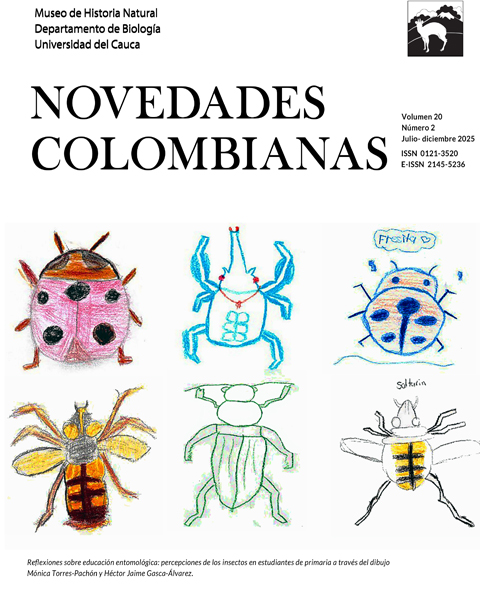
Reflections on entomological education: perceptions of insects among elementary school students through drawing
Abstract
The objective of this research is to recognize perceptions about insects in elementary school students through drawing, to promote and appreciate the diversity and conservation of these organisms. Fifty-nine students participated in the research, 35 girls and 24 boys, aged between 7 and 10 years old from the Colegio Fundación Nueva Granada in Bogotá. The intervention was carried out in four stages: 1) observation of different orders of insects, 2) creation of creative drawings, 3) assignment of a creative name, 4) socialization of the activity. Fifty-nine drawings made by the elementary school students were analysed based on the following categories: A) taxonomic knowledge of insects, B) anatomical knowledge of insects, C) insect-plant interaction, D) anthropomorphic characteristics. The order of insects that the students chose to draw was Coleoptera. In all drawings, the students recognized the head region, while the distinguishable recognition of the thorax and abdomen was not evident. Nineteen percent of the drawings included insect-plant interaction, and 27% of the drawings included symbols such as hearts or stars. In conclusion, incorporating entomology into different levels of the curriculum contributes to teaching processes, promotes science education, and provides tools to address the rapid decline in insect populations at the local level.
Downloads
References
Amat-García, G., Andrade, G. y Amat-García, E. (Ed.). 2007. Libro Rojo de los Invertebrados Terrestres de Colombia. Instituto de Ciencias Naturales- Universidad Nacional de Colombia, Conservación Internacional Colombia Instituto Alexander von Humboldt, Ministerio de Ambiente, Vivienda y Crédito Territorial. Bogotá. 204 pp.
Arango, N., Chaves, M. E. y Feinsinger, P. 2002. Guía metodológica para la enseñanza de ecología en el patio de la escuela. Enseñanza de Ecología en el Patio de la Escuela EEPE. National Audubon Society. Nueva York NY. 92 pp.
Castro-González, A. A., Gasca-Álvarez, H. J. y Villate-Vargas, L. 2025. Percepción de los insectos por estudiantes del municipio de Santana (Boyacá), mediante textos fantásticos. Revista Interamericana de Investigación Educación y Pedagogía RIIEP, 18(1): 63-84. https://doi.org/10.15332/25005421.9686
Cardoso, P., Barton, P. S., Birkhofer, K., Chichorro, F., Deacon, C., Fartmann, T. Fukushima, C. S., Gaigher, R., Habel, J. C., Hallmann, C. A., Hill, M. J., Hochkirch, A., Kwak, M. L., Mammola, S., Ari Noriega, J., Orfinger, A. B., Pedraza, F., Pryke, J. S., Roque, F. O., … Samways, M. J. 2020. Scientists' warning to humanity on insect extinctions. Biological conservation, 242: 108426. https://doi.org/10.1016/j.biocon.2020.108426
Carlson, E., Shufran, A. y Geest, E. 2025. Insects and Education: Using pre and post drawings to understand student’s perceptions of insects. Journal of STEM Education: Innovations and Research, 26(2): 46–51. https://doi.org/10.63504/jstem.v26i2.2732
Eugenio-Gozalbo, M. y Ortega-Cubero, I. 2022. Drawing our garden’s insects: a didactic sequence to improve pre-service teachers’ knowledge and appreciation of insect diversity. Journal of Biological Education, 58(3): 512-529. https://doi.org/10.1080/00219266.2022.2081243
Fiorella, L. y Mayer, R. 2016. Eight Ways to Promote Generative Learning. Educational Psychology Review, 28(4): 717–741. https://doi.org/10.1007/s10648-015-9348-9
Gómez-Prado, B., Puig, B. y Evagorou, M. 2020. Primary pre-service teachers’ emotions and interest towards insects: an explorative case study. Journal of Biological Education, 56(1): 61–76. https://doi.org/10.1080/00219266.2020.1756896
Jaun-Holderegger, B., Lehnert, H. J. y Lindemann-Matthies, P. 2022. Knowledge and perception of common local wild plant and animal species by children and their teachers–a case study from Switzerland. International Journal of Science Education, 44(8): 1318-1335. https://doi.org/10.1080/09500693.2022.2076949
Kellert, S. R. 1993. Values and perceptions of invertebrates. Conservation Biology, 7(4): 845–855. https://doi.org/10.1046/j.1523-1739.1993.740845.x
Loaiza Bustos, J. O., Torres Solano, C. L. y Ortíz Zea, J. F. 2024. Percepciones Ambientales sobre Insectos de estudiantes de básica primaria en dos Instituciones Educativas de Neiva-Huila. Revista Latinoamericana de Educación Científica, Crítica y Emancipadora, 3(1): 100-108. https://doi.org/10.5281/zenodo.13887993
Lucky, A., Janštová, V., Novotný, P. y Mourek, J. 2025. Quantifying ento-literacy: development and validation of an international insect-focused attitude and knowledge survey instrument. International Journal of STEM Education, 12(1): 1-27. https://doi.org/10.1186/s40594-025-00532-8
Martínez, L. M. 2004. Arte y símbolo en la infancia: Un cambio de mirada. Octaedro, Barcelona. 233 pp.
Matthews, R. W., Flage, L. R. y Matthews, J. R. 1997. Insects as teaching tools in primary and secondary education. Annual Review of Entomology, 42(1): 269–289. https://doi.org/10.1146/annurev.ento.42.1.269
Mayorga-Palacio, M. 2017. Artrópodos como modelo biológico para dar cuenta de la importancia de los invertebrados en el medio ambiente a través de la enseñanza de su ecología. Bio-grafía, 10(19): 827-833. https://doi.org/10.17227/bio-grafia.extra2017-7215
Ministerio de Educación Nacional (MEN). 2016. Derechos Básicos de Aprendizaje en Ciencias Naturales, Colombia. 44 pp.
Moya-Bedoya, Y., Peña-Sepúlveda, E., Builes González, Y., Coronado Peña, J. J., Pinzón Alzate, S. y Molano, A. C. 2020. Una mirada a los artrópodos desde las concepciones de los estudiantes de la escuela rural San Rafael, sede Pradera Alta, Calarcá-Quindío. Revista de la Asociación Colombiana de Ciencias Biológicas, 1(32): 77-88. https://doi.org/10.47499/revistaaccb.v1i32.209
Muñiz Estévez, L. y Torralba-Burrial, A. 2022. Conociendo los insectos en educación infantil: evaluación diagnóstica y análisis de su percepción. Didácticas Específicas, 26: 62-79. https://doi.org/10.15366/didacticas2022.26.004
OCDE. 2006. Assessing Scientific, Reading and Mathematical Literacy. A Framework for PISA 2006. https://www.oecd.org/pisa/39732471.pdf
Pinilla-Peña, D., Múñoz-Cárdenas, P., González-Galindo, D. y Gasca-Álvarez, H. J. 2025. Percepción sociocultural de los insectos en estudiantes de séptimo grado: un estudio etnoentomológico en Miraflores, Boyacá. Ciencia en Desarollo, 16(1E): 31-38. https://doi.org/10.19053/uptc.01217488.v16.nE.2025.19782
Puentes-Duarte, L. 2023. La educación ambiental en Colombia en el marco de los objetivos del desarrollo sostenible. Cienciamatria, 9(2): 408-421. https://doi.org/10.35381/cm.v9i2.1187
Rodríguez Casallas, J. y Escobar, G. 2014. “Insectos en el aula”: Una estrategia didáctica para la enseñanza-aprendizaje de la biología en el patio de la escuela. Bio-grafía, Escritos Sobre La Biología y Su Enseñanza: 476-485. https://doi.org/10.17227/20271034.vol.0num.0bio-grafia476.485
Salas, E. y Cañete-Vadulli, A. 2018. Educación científica fuera del aula: Propuesta de intervención educativa en un parque urbano abierto a la comunidad. Tecné, Episteme y Didaxis, TED, (Extraordin): 1-12. Disponible en: https://revistas.upn.edu.co/index.php/TED/article/view/8727
Sánchez-Bayo, F., y Wyckhuys, K. A. G. 2019. Worlwide decline of the entomofauna: A review of its drivers. Biological Conservation, 232: 8-27. https://doi.org/10.1016/j.biocon.2019.01.020
Sánchez Torres, A., y Reyes Del Valle, M. L. 2021. Los insectos en la escuela: una alternativa en la enseñanza de las ciencias para la construcción de una educación ambiental, reflexiva y contextual. Educación y ciudad, (40): 147-164. https://doi.org/10.36737/01230425.n40.2021.2462
Shepardson, D. P. 2002. Bugs, butterflies, and spiders: children's understandings about insects. International Journal of Science Education, 24(6): 627-643. https://doi.org/10.1080/09500690110074765
Shipley, N. J., y Bixler, R. D. 2017. Beautiful bugs, bothersome bugs, and fun bugs: examining human interactions with insects and other arthropods. Anthrozoös, 30(3): 357–372. https://doi.org/10.1080/08927936.2017.1335083
Soga, M. y Gaston, K. J. 2016. Extinction of experience: the loss of human–nature interactions. Frontiers in Ecology and the Environment, 14(2): 94-101. https://doi.org/10.1002/fee.1225
Tole, E. y Gómez, F. 2021. Los insectos: una estrategia pedagógica para aprender a reconocer el territorio en el CED rural Mochuelo alto. Bio-grafía, 14(27): 133-142. https://doi.org/10.17227/bio-grafia.vol.14.num27-14515
Torres Guerra, N. y Sánchez Medina, N. 2009. “Semillas Ambientales” en el Instituto Pedagógico Arturo Ramírez Montúfar (IPARM) de la Universidad Nacional de Colombia–Sede Bogotá. Bio-grafía, 2(2): 209-213. https://doi.org/10.17227/20271034.vol.2num.2bio-grafia209.213
Torres-Pachón, M. 2022. Enseñanza de la Ecología en el Patio de la Escuela (EEPE): Una experiencia educativa con insectos acuáticos. Bio-grafía, Número Extraordinario: 1875-1883. Disponible en https://revistas.upn.edu.co/index.php/bio-grafia/article/view/18289
van Klink, R., Bowler, D. E., Gongalsky, K. B., Swengel, A. B., Gentile, A. y Chase, J. M. 2020. Meta-analysis reveals declines in terrestrial but increases in freshwater insect abundances. Science, 368(6489): 417-420. https://doi.org/10.1126/science.aax9931
Copyright (c) 2025 Universidad del Cauca

This work is licensed under a Creative Commons Attribution-NonCommercial-NoDerivatives 4.0 International License.


.png)