
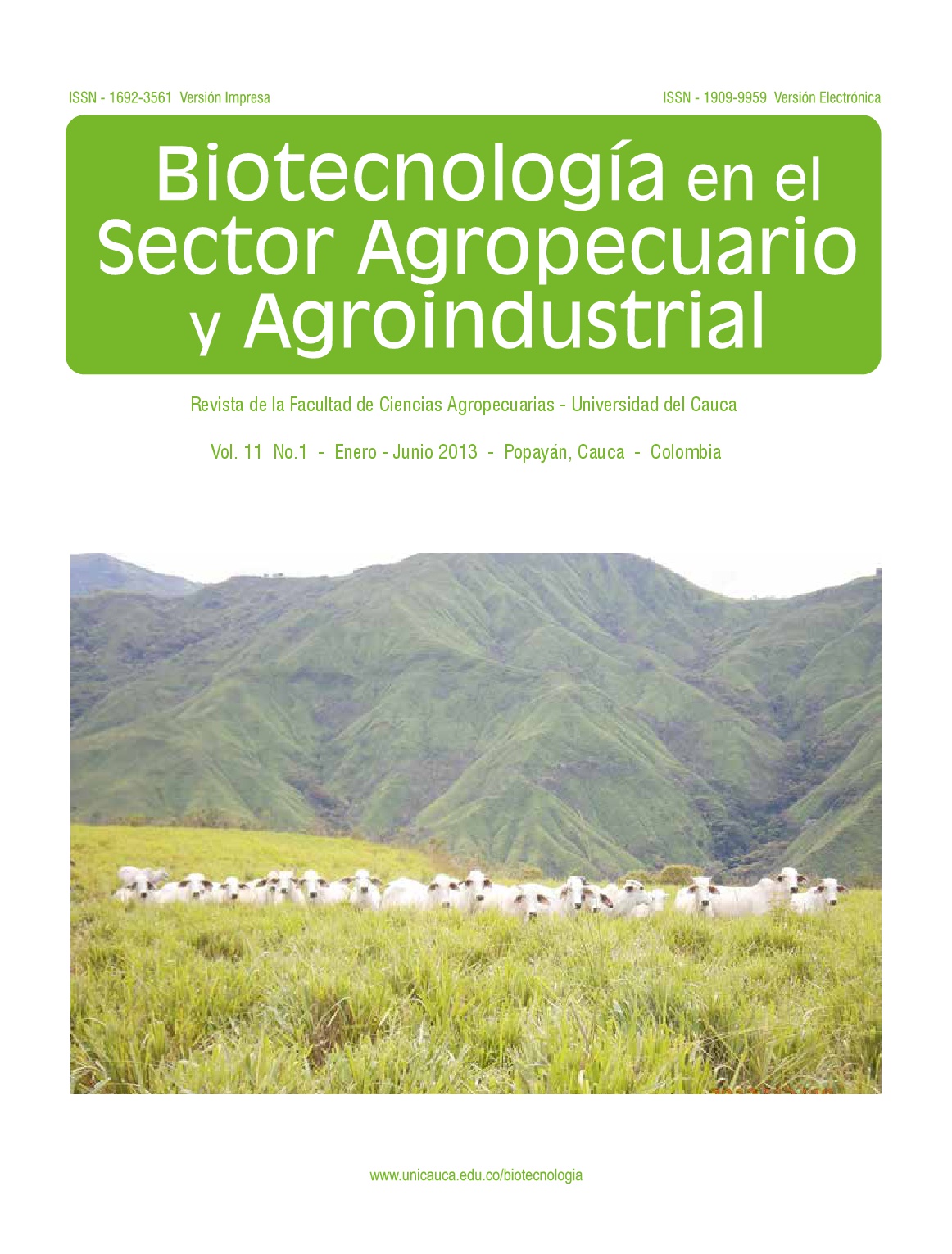
Treatment of dairy industry wastewater using beneficial microorganisms
Abstract
The wastewater generated in the dairy industry has high pollutant loads show impacts on receiving hydrological systems, so, more powerful techniques are necessary to achieve the reductions imposed by environmental Colombian regulations. The research process leading to the results presented here evaluated the ability of a mixture of beneficial microorganisms (MB) to reduce contaminants in waste loads generated at a plant in industrial wastewater treatment dairy, with the indicators, biological oxygen demand (BOD5), chemical oxygen demand (COD), total suspended solids (TSS) and total solids (TS) for two different types of waste, wash water (morning) and process water (afternoon), there were reductions in COD of 71,65% (afternoon) and 66,96% (morning) in the BOD5 of 68,58% (afternoon) and 61,22% (morning) in the ST of 70,45% (afternoon) and 70,34% (morning) and for SST reductions were achieved 78,77% (afternoon) and 71,48% (morning). Experimental results were analyzed through an analysis of variance (ANOVA) allowing find some level of interaction between selected response variables. Finally, some recommendations are necessary to achieve compliance with environmental Colombian regulations regarding quality and uses of water resources.Downloads
Languages:
es,enReferences
AYMERICH, S. Conceptos para el tratamiento de residuos lácteos. San José (Costa Rica). Centro Nacional de Producción Más Limpia, 2000, p.12-23
ALFARO, O., JUANTORENA, A. y FONSECA, S. Alternativas para el tratamiento de los residuales del combinado lácteo Santiago. Parte II. Revista Tecnología química, 22 (1), 2002, p. 10-18.
FEDEGAN. Plan Estratégico de la Ganadería Colombiana 2019. Bogotá (Colombia): 2006, 294 p.
ROSA, M.A., PERALTA, J.M., GILLI, D. A. y BOSCO, D.M. Cinética de la Biodegradación de un Efluente Lácteo: Aplicación de Técnicas de Análisis de Datos para la Comparación de Modelos. Información
tecnológica, 19 (4), 2008, p. 11-18.
GONZÁLEZ, J., VALDÉS, P., NIEVES, G. y GUERRERO, B. Aplicación de la digestión anaerobia a los residuales de las industrias lácteas. Revista
Internacional de Contaminación Ambiental, 10 (1), 1994, p. 37-41.
CHÁVEZ, M., TAJADA, R. y MEJÍA, D. Actividad enzimática del lodo granular en reactor UASB tratando efluente lácteo. Revista del Centro InvestigacionesBiológicas, 39 (3), 2005, p. 293-299.
CHRISTOPHERSON, S., SCHMIDT, D. and JANNI, K. Evaluation of Aerobic Treatment Units in Treating High Strength Waste From Dairy Milk
Houses. American Society of Agricultural and
Biological Engineers, 2003, p. 172-177.
COLOMBIA. MINISTERIO DE SALUD. Decreto 1594 de 1984: Usos del agua y residuos líquidos. Bogotá (Colombia): 1984, 45 p.
WANG, L., HUNG, Y., and LO, H. Handbook of Industrial and Hazardous Wastes Treatment. 2 ed.New York (United States of America): Marcel Dekker,2004, 1345 p.
LONDOÑO, M. Efecto de los microorganismos eficientes sobre la calidad del ensilaje de maíz y su utilización en lechería tropical [Tesis de pregrado]. Bogotá (Colombia): Universidad de Lasalle,Facultad de Zootecnia, 2008, 123 p.
FIORAVATI, M., VEGA, C., HERNÁNDEZ, C., YEOMANS, J. y OKUMOTO, S. Eficiencia de los microorganismos eficaces (EM) en la estabilización de lodos sépticos para su uso agrícola. Revista
Tierra Tropical, 1(09), 2005, p. 69-76.
MIYASHIRO, G. y MEGGS, J. Medición del efecto de la aplicación de Microorganismos Eficaces (EM) en la generación de gas metano (CH4) en
los sistemas biodigestores a escala [Tesis de licenciatura]. San José (Costa Rica): UniversidadEarth, 2007, 59 p.
GAVIRIA, E. y MARTÍNEZ, L. Desarrollo de un producto para saneamiento ambiental basado en cocteles de microorganismos y diseño de su producción comercial [Tesis de licenciatura]. San José (Costa Rica): Universidad Earth, 2004, 48 p.
APHA – AWWA – WPCF. Métodos normalizados para el análisis de aguas potables y residuales. 17e. Madrid (España): Díaz de Santos, 1992, p. 5-11
ATLAS, R., y BARTHA, R. Ecología microbiana y microbiología ambiental. 3 ed. Madrid (España): Addison Wesley, 1998, 677 p.
ASOCIACIÓN COLOMBIANA DE INGENIERÍAS SANITARIA Y AMBIENTAL (ACODAL). Control de calidad del agua para consumo. Cali (Colombia): 1993, 29 p.
MILLIPORE. Análisis de agua. Ed 1995-1996. Bogotá (Colombia): 1996, 258 p.
RASHID, M. and WEST, J. Dairy wastewater treatment with effective microorganisms and duckweed for pollutants and pathogen control.
Wastewater Reuse –Risk Assessment, DecisionMaking and Environmental Security, 2007, p. 93–102.
CÓRDOBA, A. Evaluación de los Microorganismos Eficientes (SCD EM™) en el Tratamiento de Aguas Residuales domesticas mejorando las características de vertimiento final [online]. Available:http://www.grupoprotech.net/scdem/ publicaciones/informefinalptar.html [citado 21 de mayo de 2009].
LIAO, L., SHAO, X., XU, J.Z. and WALTER, M. Effects of Different EM Solution Addition Ratios and Incubation Methods on Dairy Effluents
Treatment. 2nd International Conference on Bioinformatics and Biomedical Engineering. Shangai (China): 2008, p. 3466-3468
GUIZHONG, Z. and JING, S. Study on Effective Microorganisms Bacteria for Acrylonitrile Wastewater Treatment. 4th international conference Bioinformatics and biomedical engineering (iCBBE).
Chengdu (China): 2010 p. 1,4, 18-20
GUIZHONG, Z., JIA, L., HUIJU, F., JING, S. and XIAOQING, Z. Starch Wastewater Treatment with Effective Microorganisms Bacteria. 4th international conference Bioinformatics and biomedical engineering (iCBBE). Chengdu (China): 2010,p.1,4, 18-20.

 Spanish
 English




















.png)